{
"url":"/mutual-funds/equity-funds/bajaj-finserv-elss-tax-saver-fund",
"nav_id":"TFRGG",
"debt": "Debt/Cash 100%",
"equity": "Equity 0%",
"TFRGG": {
"nav": "10000",
"date": "31-10-2024",
"since": {
"bajajflexi": "7.19",
"bajajsmall": "7.33",
"bajajnifty": "7.24"
},
"6_month_ago": {
"bajajflexi": "7.31",
"bajajsmall": "7.43",
"bajajnifty": "7.54"
}
},
"TFDGG": {
"nav": "10001",
"date": "31-10-2024",
"since": {
"bajajflexi": "7.38",
"bajajsmall": "7.33",
"bajajnifty": "7.24"
},
"6_month_ago": {
"bajajflexi": "7.50",
"bajajsmall": "7.43",
"bajajnifty": "7.54"
}
}
}


Bajaj Finserv ELSS Tax Saver Fund


Equity
Regular Growth

NAV Risk Type
₹--
as on 3-12-2024
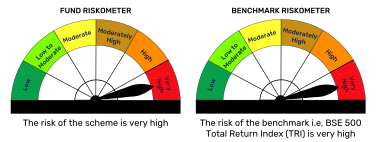
Very High


notifier-imgThis is an equity, ELSS fund with BSE 500 Total Return Index (TRI) as its benchmark. The risk level for this fund is categorized as Very High.
 

Category of Scheme

ELSS fund

Benchmark

BSE 500 Total Return Index (TRI)

Min. SIP Amount

₹500

Inception Date

29-01-2025


Benefits of investing in Bajaj Finserv ELSS Tax Saver Fund

Tax efficiency

The scheme is eligible for tax benefits under Section 80C of the Income Tax Act, 1961. Additionally, long-term capital gains from equity-oriented mutual funds are tax-free up to Rs. 1.25 lakh per year, with excess gains taxed at 12.5%.

Long-term oriented stock selection process

Identifying stocks through fundamental analysis, ensuring fair valuation, and adopting a buy-and-hold strategy by investing in businesses with strong growth potential.

InQuBe

Our inhouse InQuBe investment philosophy brings informational, quantitative & behavioural edge to the portfolio.


Investment Objective

To generate long term capital appreciation from a diversified portfolio of predominantly equity and equity related securities while offering deduction on such investment made in the scheme under Section 80C of the Income Tax Act, 1961.

However, there is no assurance that the investment objective of the Scheme will be achieved.

About the Bajaj Finserv ELSS Tax Saver Fund

Bajaj Finserv ELSS Tax Saver Fund is an equity-linked savings scheme designed to help investors combine tax saving under Section 80C of the Income Tax Act, 1961, (Old Regime) with the long-term growth potential of equities.

Key features include:

  • Invests at least 80% in equities with a three-year lock-in.
  • Uses a fundamentals-driven approach to stock selection, focusing on businesses with steady long-term growth potential.
  • Builds a diversified portfolio across sectors to balance risk and return potential.
  • Powered by Bajaj Finserv AMC’s InQuBe philosophy—Information, Quantitative and Behavioural edges—to aid robust decision-making and disciplined investing.


Asset Allocation

The asset allocation pattern of the Bajaj Finserv ELSS Tax Saver Fund is as follows:

Instruments Indicative allocations (% of total assets)
Minimum Maximum
Equities & Equity related securities 80% 100%
Debt and Money Market Instruments* and Units of Mutual Fund schemes 0% 20%

*Debt instruments shall be deemed to include securitized debts (excluding foreign securitized debt). Money market instruments will include Commercial papers, Commercial bills, Treasury bills, Government securities having an unexpired maturity up to one year, Tri-party Repos on Government securities or treasury bills (TREPS), Certificate of deposit, Usance bills, permitted securities under a repo / reverse repo agreement and any other like instruments may be permitted by RBI / SEBI from time to time, subject to necessary regulatory approvals.
 

Who should invest in Bajaj Finserv ELSS Tax Saver Fund?

  • Salaried individuals: Seeking tax benefits and better post-tax returns over long term.
  • First-time investors: Exploring equity investments with a tax-saving incentive.
  • Long-term investors: Aiming for wealth creation through disciplined investing.
 

Fund Managers

Nimesh Chandan
Chief Investment Officer
Sorbh Gupta
Head – Equity
Siddharth Chaudhary
Head – Fixed Income


Fund Details

Type of Scheme

An open ended equity linked saving scheme with a statutory lock in of 3 years and tax benefit


Minimum Application Amount

  • Lumpsum: Rs. 500/- and in multiples of Rs. 500/- thereafter.
  • SIP: Rs. 500/- and in multiples of Rs. 500/- thereafter (minimum 6 instalments)
 

Load Structure/Lock-In Period


Entry load - Nil

Exit Load - Nil
The Trustee / AMC reserves the right to change the load structure any time in the future if they so deem fit on a prospective basis. The investor is requested to check the prevailing load structure of the scheme before investing.
 

Total Expense Ratio (TER)

Click Here

to view Total Expense Ratio


Options/Sub-Option

  • Bajaj Finserv ELSS Tax Saver Fund – Direct Plan
  • Bajaj Finserv ELSS Tax Saver Fund – Regular Plan
  • Growth option
  • Income Distribution cum Capital Withdrawal (IDCW) option with Payout of IDCW sub-option.
  • The scheme will have a common portfolio across various Plans/Options/Sub-options.
  • Investors are requested to note that Growth and IDCW Option (Payout) under Regular and Direct Plans will have different NAVs. These NAVs will be separately declared.
  • Bajaj Finserv ELSS Tax Saver Fund - Direct Plan is only for investors who purchase /subscribe units in a Scheme directly with the Fund.
  • Default option will be Growth Option.
  • Default sub-option will be Payout of IDCW sub-option.
  • For detailed disclosure on default plans and options, kindly refer SAI.
 

Product Label and Riskometer

Bajaj Finserv ELSS Tax Saver Fund
An open ended equity linked saving scheme with a statutory lock in of 3 years and tax benefit

This product is suitable for investors who are seeking*:

  • Wealth creation over long term
  • To invest predominantly in equity and equity related instruments with tax benefit under Section 80C of Income Tax Act, 1961
*Investors should consult their financial advisers if in doubt about whether the product is suitable for them
 

ELSS Fund Overview

Equity-Linked Saving Scheme (ELSS) is a unique investment option that aims for potential wealth creation while also offering tax benefits under the provisions of Section 80C of the Income Tax Act, 1961. ELSS primarily invests the major corpus of money (minimum 80% of the portfolio) in equities and equity-related securities.
There is no minimum allocation required in each market capitalization, so the fund manager is free to plan the flexi cap fund investment portfolio as per their growth strategy, market knowledge and insights.

Furthermore, these funds have the shortest lock-in period among all tax-saving investment options. The mandatory lock-in period for ELSS is just three years.

In recent years, many salaried investors have opted for ELSS funds for tax benefits. After the lock-in period is over, the units can be redeemed or switched, or you can also continue your investments for long term wealth creation.

Investments in ELSS funds are eligible for a tax deduction of up to Rs. 1.5 lakh under Section 80C of the Income Tax Act. So basically, the amount you invest in ELSS can be subtracted from your total taxable income, thereby reducing your tax liability.

Bajaj Finserv ELSS Tax Saver Fund - Regular & Direct Plans

You can invest in the Bajaj Finserv ELSS Tax Saver Fund through two plans: Direct and Regular. Here’s are the details of each:

Basis Direct Plan Regular Plan
How you invest You invest on your own without the help of a mutual fund distributor You invest through a distributor who guides you through the process
Role of intermediary No intermediary involved Distributor acts as an intermediary
Commission cost No commission costs Commission is paid to the distributor
Expense ratio Lower expense ratio due to absence of commission Higher expense ratio due to distributor commission

In both direct and regular plans, you can choose between the growth and IDCW options. For instance, you can opt for Bajaj Finserv ELSS Tax Saver Fund Direct Growth option or Bajaj Finserv ELSS Tax Saver Fund Direct IDCW Payout. Similarly, you can choose Bajaj Finserv ELSS Tax Saver Fund Regular Growth option or Bajaj Finserv ELSS Tax Saver Fund Regular IDCW Payout. In the growth option, all potential profits earned by the fund are reinvested. In the IDCW option, the fund may distribute income to investors from time to time, subject to availability of distributable surplus.

How to invest in Bajaj Finserv ELSS Tax Saver Fund

To invest in Bajaj Finserv ELSS Tax Saver Fund, you can choose between two different approaches.

  • Offline mode: In this mode, you fill out an application form and submit it to your distributor or an AMC of your choice.
  • Online mode: In this mode, you invest directly with your Demat account. Another way to invest is through the Bajaj Finserv AMC website. Here, you can create an online account and select the Bajaj Finserv ELSS Tax Saver Fund to invest through SIP or lumpsum. invest now.

Taxation on Bajaj Finserv ELSS Tax Saver Fund

As Bajaj Finserv ELSS Tax Saver Fund is an equity mutual fund, it follows the tax rules that apply to all equity-oriented schemes. The tax you pay depends on how long you have stayed invested.

  • Short-term capital gains (STCG):
    If you redeem your units within a year of purchase, any gains are classified as short-term and taxed at 20%, along with applicable surcharge and cess.
  • Lon-term capital gains (STCG):
    If you redeem units after a tear or more, your gains are considered long-term. In this scenario, gains up to Rs. 1.25 lakh in a financial year are exempt from taxation. Any gains above this limit are taxed at 12.5%, along with applicable surcharge and cess.

Explore Related Equity Funds

Flexi Cap Fund Healthcare Fund Multi Cap Fund
Large and Mid Cap Fund Small Cap Fund Large Cap Fund
Consumption Fund Banking and Financial Services Fund  

Explore All Schemes

Equity Funds Debt Funds Hybrid Funds Index Funds
Exchange Traded Fund Funds Savings Plus All Mutual Funds  
 

Frequently Asked Questions

Bajaj Finserv ELSS Tax Saver Fund is a mutual fund that invests in equities with long-term growth potential along with tax benefits under section 80C of the old regime of the Income Tax Act, 1961.

ELSS Funds carry a lock-in period of 3 years during which investors cannot redeem their invested amount

Investors can claim a maximum exemption of Rs. 1,50,000 by investing in ELSS Funds under sec 80C of Income Tax Act, 1961. The exemption is available for investors under the old tax regime. Exemptions are subject to prevailing tax laws.

Bottom-up stock selection: Identifying stocks through fundamental company analysis
Ensure appropriate valuation: Evaluation of fair pricing for long-term investment
Buy and hold growth: Investment in businesses with strong future potential

You can invest in Bajaj Finserv ELSS Tax Saver Fund through both online and offline channels. You can invest independently or with the help of a distributor.

ELSS funds are a type of mutual fund. The suitability of mutual funds, including ELSS funds, depends on your goals, risk appetite and preferences.

No, ELSS funds are not tax-free after the 3-year lock-in period. While investments up to ₹1.5 lakh in a financial year are eligible for deduction under Section 80C of the Income Tax Act, 1961, (old tax regime), gains on redemption are subject to long-term capital gains tax. Capital gains exceeding ₹1.25 lakh in a financial year are taxed at 12.5%, plus applicable surcharge and cess.

Like all equity investments, ELSS Funds carry market risk and can experience high volatility, especially in the short term. Additionally, they come with a three-year lock-in period, which can make them unsuitable for those who need liquidity in the near term.

Investments of up to Rs. 1.5 lakh in ELSS funds each financial year are eligible for tax deduction under Section 80C of the Income Tax Act, 1961, as per the old tax regime. This means you can claim the tax benefit every financial year, provided you invest in ELSS (or other eligible options) during that year.

Yes, redemptions are allowed in the ELSS Tax Saver Fund after the lock-in period ends for your investment.

No, ELSS funds are subject to market risk and performance/returns are not guaranteed; they depend upon market conditions.

You can use tools such as CAGR calculators and XIRR calculators to estimate the returns on your ELSS tax saver fund returns. You can also refer to AMFI and other reputable websites, along with your AMC’s website, for latest returns data.

Past performance may or may not be sustained in future.

The NAV of a fund can fluctuate depending on market conditions and is calculated at the end of each trading day. The latest NAV is displayed on the top left of this page.

To access information about the current AUM of Bajaj Finserv ELSS Tax Saver Fund, you can download the latest Factsheet from the Bajaj Finserv AMC website.

The fund’s risk classification is based on the portfolio composition as well as SEBI guidelines and is subject to periodic review. Refer to the Riskometer above on this scheme page and latest scheme-related documents for the current risk level.

The fund’s top holdings are selected by the fund manager and may change over time based on market outlook and research insights. To view the most up-to-date holdings, please check the latest Factsheet or Scheme Page.

Asset allocation of the Bajaj Finserv Large Cap Fund is as per the Scheme Information Document (SID). For the current allocation across equity and other instruments, please refer to the most recent Factsheet or the Scheme Page

The Total Expense Ratio (TER) may differ for Direct and Regular plans and can change over time. For the most current expense ratio, please refer to the latest Factsheet or the Total Expense Ratio section.

An ELSS tax saver fund SIP may potentially benefit you as it allows you to invest gradually while benefiting from tax deductions under Section 80C (old tax regime) of the Income Tax Act, 1961. It also helps inculcate disciplined investing and may average out the purchase cost over market cycles, potentially helping mitigate the impact of market volatility. However, a very high risk appetite is needed for equity funds.

ELSS funds may be considered as part of long-term financial planning due to their equity exposure. However, ELSS tax saver fund performance is market-linked and may vary across market cycles. Suitability depends on individual goals, time horizon, and risk tolerance.

The term for income distributed by mutual funds is no longer called dividend, it is called IDCW Payout. Such income received from ELSS funds are taxable in the hands of the investor. They are taxed as per the investor’s applicable income tax slab rate.

The NAV is calculated at the end of every business day. The latest NAV can be viewed at the top of the Bajaj Finserv ELSS Tax Saver Fund’s scheme page and on the AMFI website.

Learn About Mutual Funds

Posted On: 01 November 2023

Investors have multiple choices when it comes to investment options in India. But if you…

Posted On: 03 March 2024

Investing in equities requires a disciplined approach. One of the most significant challenges that investors…

Posted On: 29 November 2023

Tax-saving investment avenues have always held a special place in the hearts of Indian investors.…

Related Video

Be Future-Ready With Megatrends | Bajaj Finserv Flexi Cap Fund

Posted On: 30 Aug 2023

Benefit From Megatrends With Bajaj Finserv Flexi Cap Fund

Posted On: 30 Aug 2023

Long-Term Megatrends Investing with Bajaj Finserv Flexi Cap Fund

Posted On: 30 Aug 2023
 
arrow upGo to the top